

The elegant first paragraph of Niall Williams’s latest book, O Now!, reminds me why my first child is called Isobel, named (with a vowel shift) after a character in his tender debut novel, Four Letters of Love, from 1997, which he adapted for the 2024 film starring Pierce Brosnan, Helena Bonham Carter and Gabriel Byrne.
O Now! begins with elderly neighbours Bat and Ganga, sitting in companionable silence in the latter’s thatched cottage, which “had not taken the electricity when it was passing”, waiting to see who will die first, “the ashes of evening fallen through the grate”.
It’s the end of October, “a month so needled with rain it seemed the heavens wanted to stitch themselves onto the earth and make life and afterlife all the one”.
Originally commissioned for BBC Radio, it is a warm, wise and witty short story, set in Faha, the imaginary west Co Clare village that has inspired his writing since the 2014 Booker Prize-longlisted History of the Rain, followed by This Is Happiness, from 2019, shortlisted for An Post Novel of the Year, and Time of the Child, from 2024, winner of the Kerry Group Irish Novel of the Year Award.
READ MORE


In an enlightening afterword, the author explains how Faha was invented on Easter Sunday in 2011 after dinner with his old friend and neighbour Martin Keane, to whom the book is dedicated, when a large Ordnance Survey map of southwest Clare and the Shannon Estuary was produced.
His previous book, John, about the Evangelist’s resurrection of the fading story of Christ, had spiritually exhausted him. He withdrew from writing into reading.
Then his father died. In his handwritten will, his father had written: “To Niall, my books.” “It remains one of the most moving sentences I have ever read,” Williams writes – four words of love, to play on the title of his debut novel.
Connecting with his late father through his books, “the idea of books as reliquaries of spirit, not just of those of their writers but those of their readers too, I began to imagine a girl whose father had died and left her his books”. This would become History of the Rain, whose protagonist, Ruth, is confined by illness to bed so learns of Faha through stories. She is entranced, as is her creator.
Williams had moved to west Clare in 1985; it and its people had got under his skin and filled his imagination. He wanted to celebrate their generosity, largeness of spirit, community, endurance, dignity and humour. To write, in short, out of love and about love.
“I knew the risks of this, the pitfalls of sentimentality, nostalgia and all the rest, as well as the courage that would be needed during these fraught times to write this way.”
As a method, he had two examples to follow, the winding local roads that followed the contours of the land and traditional Irish music with its sinuous digressions and ornamentations.
“Music has been really important to me, when I was younger especially, in feeling less alone in the world and less peculiar. Writing the Faha novels, I listen to the music of Martin Hayes and The Gloaming. I feel fortunate to be living in a time when Martin Hayes exists.”
And he had the wisdom of an early inspiration to follow. “It is a great blessing,” Flannery O’Connor wrote, “perhaps the greatest a writer can have, to find at home what others have to go elsewhere seeking.”
When I am planning my trip to visit him, Williams recommends a slight detour along the broad, majestic Shannon Estuary to Labasheeda, which means Bed of Silk in Irish, before turning inland to Kilmihil, the nearest village to the home in Kiltumper that he has shared with his wife, Chris Breen, since they moved from New York, in 1985.
Theirs is a beautiful home, the original four-roomed cottage that once belonged to Breen’s grandfather tastefully extended and modernised but with a reverence for tradition. There is the conservatory where Williams writes for a couple of hours each morning, and the old sittingroom with its huge hearth and wood-burning stove, where he used to run his creative-writing workshops. They are now held in the Old Ground Hotel in Ennis, with alumni such as author Helen Cullen.
By the stairs is a framed poster of his play The Murphy Initiative, from 1991, a comedy about Americans looking up their roots. Talent-spotted by Garry Hynes, he was the first Irish playwright since O’Casey whose debut premiered on the Abbey’s main stage.
It was a calamitous production, however, the details of which must remain off the record, he says, but I am left cringing with second-hand embarrassment. The Irish Times review was headlined: “Total waste of a bad idea.”
“I now look on it as thank God, because otherwise I’d still be trying to make it as a playwright, and I know how hard it is. It’s a miracle if you see a good play. Everything has to align.”
More happily, the downstairs bathroom is decorated with two framed short stories from The Irish Press: Apples in October, by Williams, and Queens’ Irish, by Breen. He was 19 or 20 when his first story, Love, was published by David Marcus in The Irish Press, resulting in a cheque for £25 before he had a bank account but, more importantly, gifting him self-belief.
“You saw your name in the paper. It almost didn’t seem like it was you, but you recognised something of your spirit had gotten outside you and is there.”
His style was not yet formed, but he identifies his preoccupations, “older people, and ruralness or nature, and somehow not of the place and time that I was living in”.
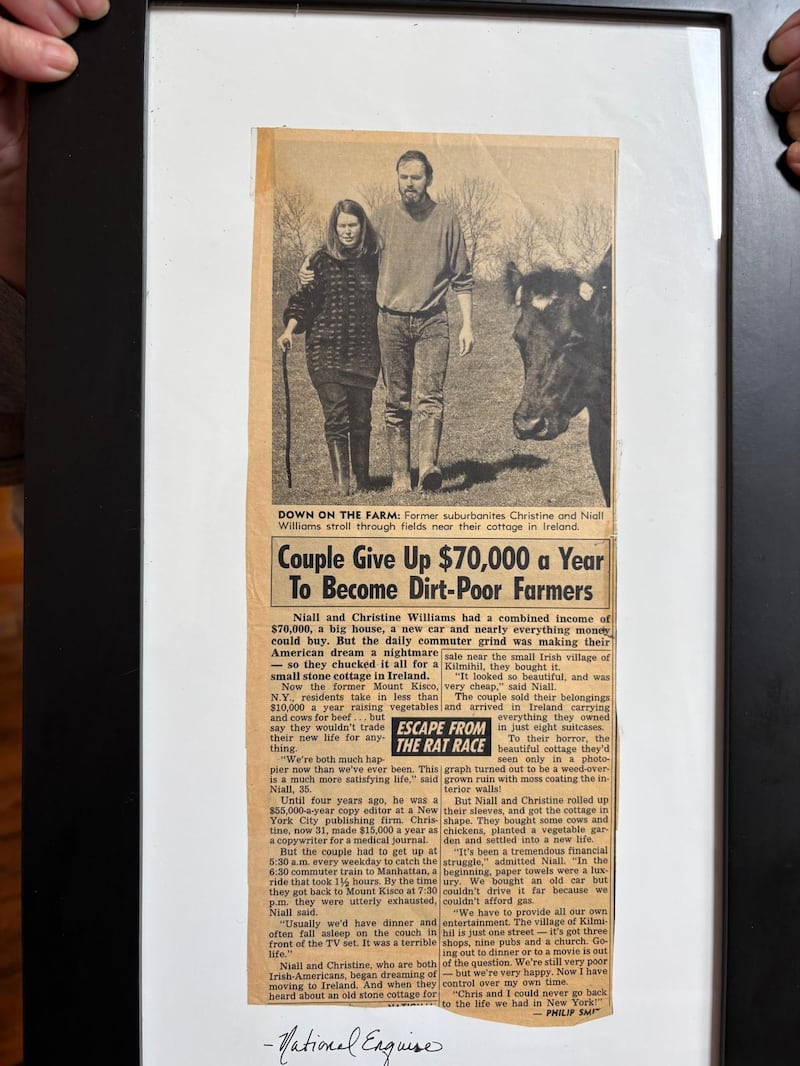
Breen shows me a framed news story from the National Enquirer, headlined “Couple Give up $70,000 a Year to Become Dirt-Poor Farmers”, with a photograph of their younger selves walking the land in their wellies as a cow looks on sceptically.
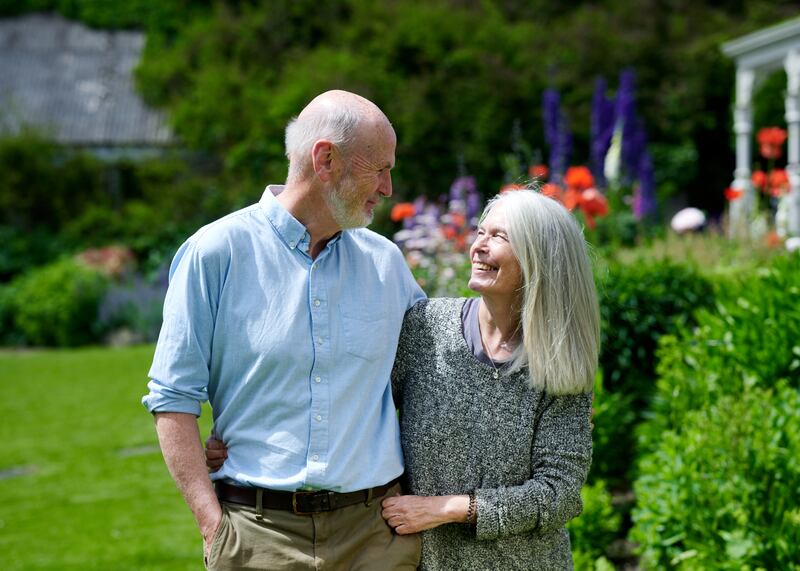
Over a lunch of butternut squash Thai curry, followed by home-made wheaten bread and blue cheese, it becomes clear that Williams and Breen are not just husband and wife but a close creative partnership.
“The ideas that we both had from the start is that we are creating a life, and that that is a joint creation, which includes everything from the garden to the family, the books, Chris’s paintings.”
The flowers on the table are from the beautiful garden that wraps around their home. He points out Breen’s drawings on the wall behind me, which illustrated In Kiltumper, from 2021, their book marking a fifth decade in this place.
The couple met in the cafeteria in University College Dublin, where Williams was writing a master’s on William Faulkner and Breen, a New Yorker of Irish heritage, was doing one on John Banville.
“Those were our chat-up lines, basically,” Williams says. “I had never heard of John Banville,” he adds.
“There’s my headline,” I joke, but of course he was 21, and Breen says that Declan Kiberd, her mentor, hadn’t heard of Banville then either.
University meant the luxury of four years’ reading. He went to very few lectures. He loved Faulkner’s passionate intensity, his raw emotional power married to extraordinarily powerful, at times biblical language.
Williams found UCD ugly where he wanted beauty, and wished he had gone to Trinity College Dublin, but he recalls the fierce intelligence of his lecturer Denis Donoghue and the brilliance of Frank McGuinness acting in Richard II.
He felt he was “a person of no parish, just a floating intelligence and sensitivity”, not just because he was from suburban Kilmacud rather than idyllic Kiltumper, but also because of “my sensibility, shy, socially awkward and a bit removed”.
He had found a home in literature but was looking for the source.
“So here’s the thing. This will sound grandiose, but when I’m in college and I’m reading Yeats, I’m getting an imagined idea of the west of Ireland, with no lived experience whatsoever. And as I read more, I eventually came to think about Synge as a model.”
James Joyce said the shortest way to Tara was via Holyhead. Williams and his future wife spent five years commuting to Manhattan from upstate New York before they resigned from the rat race to try out the good life in her grandfather’s old cottage in Clare.
The early years were a struggle, but they wrote a successful series of nonfiction books – sample title O Come Ye Back to Ireland, which appeared in 1987 – about their new life, which sold well in the US. “I view them now as a kind of apprenticeship,” he says.
It would take almost 30 years for Williams to know the place well enough to fictionalise it. A stellar review in The New York Times led to a 20-minute segment on Good Morning America and St Patrick’s Day appearances alongside Pierce Brosnan and The Chieftains. Then readers started tracking them down. They stopped taking names after the 300th visitor.

Fiction was always the goal. Unlike his debut play, his debut novel was a triumph. To what extent was Four Letters of Love his own love story?
“Nothing in my fiction is autobiographical, in the sense of taking incidents from my life, returning them into fiction. It’s against the idea that fiction is the art of other people. However, obviously all of it comes through you. Looking back at it all these years later, I can say, okay, William’s [note the name] decision to quit the Civil Service and follow a vocation which may not be real to become an artist is certainly our decision to leave paid jobs in New York, move to the west of Ireland, in the hope that you have some talent.”
His father had risen to be head of the ESB but was from a modest background in Ringsend, Dublin. Class, though, is not a preoccupation of the writer. Or any agenda.
“When I’m writing fiction, he says, “I’m trying to be inside the person, and inside the other person, and inside the place. I’m not writing from the point of view of an idea or ideology. I have no plot. I’m making it up, one sentence at a time, each time trying to be the person. Iris Murdoch said fiction is the art of other persons, and I believe that to be true.
“For me, all writing begins in reading. The reason I became a writer was that I wanted to repeat the intensity of the pleasure of my experiences as a reader. Living in another world. When Mr Mason, our English teacher in Oakland CBS, read Great Expectations aloud, and Pip fell in love with Estella, I fell in love with Estella. I try to achieve that closeness in my writing. And for the reader to feel it, you have to feel it first.”
This also informs Williams’s teaching. “I read fiction, largely, to meet people. The goal of fiction writers is to put a person on the page, to do the highest possible justice to a human being in all their complexity and richness.
“I get students to notice where a physical detail becomes dynamic and takes you below the surface of a person and suggests a depth. Like when Pip sees Mr Jaggers with the black dots where his beard keeps trying to come through.”
The goal is also to find one’s own voice. Just as Williams learned to speak by imitating his mother, he learned to write by imitating Faulkner until he developed his own voice.
Ann Patchett, a famous fan of Williams, interviewed him and Breen for her bookstore’s podcast. He recounted how Chris, his first reader, read the first draft of Time of the Child before pronouncing it “pure Niall Williams”. He responded: “You mean, Niall Williams with all his redundancies, excesses and sentimentality?”
It is part of Breen’s job as editor to prune. But he now recognises that her verdict is his mission.
“The goal is actually ‘Kilroy was here’, to be true to yourself, your own signature.
“Where I go ‘wrong’ is where I fall in love too much with the same rhythm. And that’s where Chris has a really clear eye and a great ear. She’s always right.”
I ask Breen to define the essence of Williams.
“Besides the relationships, which are so important, this compassion, empathy that he has for all sorts of people. His humour, and his language. Sometimes I say cut that back a little bit, change the pace here. Sometimes when I read it I’m just amazed how great the sentences are, so lyrical, beautiful,” she says.
“Maybe people think it’s too purply or flourishing. I don’t. I think Niall has a kind of direct line from Irish writers starting even before Oscar Wilde, like Jonathan Swift. I love that he wants to stay now in this little village of Faha. I can’t wait to see what’s next.”
History of the Rain, although set in Faha, takes place in the attic room of the Williams home, transported to somewhere like Labasheeda on the Shannon Estuary, and close to the present day.
“I felt something released in me writing it,” the author says. “By the time I finished it, I thought, do I dare walk out into Faha itself?”
And so This Is Happiness, set in 1958 as electricity comes to Faha, begins with a stranger, Christy [again, note the name], walking into town. “In the writing of it, something happened to me that had never happened before, and that is that I didn’t want to finish it. I really loved being there. The 40 years that I’ve spent living in west Clare was coming through.
“My main experience of living here is of people’s goodness. People are extraordinarily decent. If I broke down anywhere in the parish, I would be certain that people would help me. People have been helpful to us when Chris had cancer, when we were adopting our children.
“I fell in love with the characters, their world, and before finishing it I realised that I would not again leave that parish, that I was home. I was fictionally home. For better or for worse, fearing how it might be received in Ireland, you’re thinking nostalgia and sentimentality and you’re aware of all of that. But yet this is what I have to offer.”
Williams quotes the Latin construction “non solum sed etiam” – not only but also. “That’s my experience of life: there’s this, but there’s also that.” His gift is to focus on the good stuff. “The force of darkness is understood to be there, but I write with a sense of ‘despite’ – despite all the terrible things, there yet endures goodness.”
He has spoken of feeling bereft as a lover of language after the Catholic Church replaced Latin with the vernacular, a translation devoid of exaltation. It makes me think of the heightened language of his fiction as a kind of Latin, a transcendent tongue for talking of things spiritual and metaphysical.
“That’s centrally important to me, absolutely,” he says.
Time of the Child takes place in 1962, a Christmas story where the local doctor and his daughter Ronnie take in an abandoned baby. The author and his wife have two adopted children, Deirdre and Joseph. One works in fashion in New York, the other for a homeless charity in Dublin. “The adoption in Time of the Child is definitely inspired by that.”
And the relationship between Ronnie and the baby is inspired by Williams first holding his grandchild in his arms and feeling his heart expand. “It is also one of the planks of Christianity to love a stranger.”
“I’m trying to do justice to these people,” Williams says. “We know people like Ganga and Bat and how they are. You’re trying to make it as physical as possible, the body, the smoke and the fire. At the same time you’re trying to reach for something spiritual out of that physical groundedness.”
He plans to stay in Faha, moving forward four or five years with each novel, for as long as he is able. He turns 70 in 2028, and his next novel is set in 1968. It follows Jude, who finds the baby in Time of the Child and is now 18.
I’m not trying to write realistic fiction about what it’s like to live in west Clare
— Niall Williams
Williams agrees that he has a mythic imagination, like his heroes Faulkner, Melville and Márquez, focusing on a place and connecting it to something universal and timeless, the larger picture, as in Patrick Kavanagh’s poem Epic: “I made the Iliad from such / A local row.”
He also has a strong affinity to Synge. “The people that he writes are imagined, a marriage between the imagined and the actuality of being with the people. And I feel the same thing.
“I’m not trying to do exact verisimilitude; that’s not at all interesting to me. In the same way nobody ever spoke like Synge’s characters spoke. It’s imagined, poeticised. I’m not trying to write realistic fiction about what it’s like to live in west Clare.”
Williams’s novels began with a strong shade of magic realism that over time has become a granular realism.
“When I first started writing fiction,” he says, “literature was my biggest experience, so I was writing fiction that’s born of fiction. The influence of Gabriel García Márquez, Faulkner, all the South and Latin American writers was more important to me than where I was.
“I will always be an outsider no matter where I am, even here after 41 years, And that’s okay. I understand that is my nature and my role and who I am. I feel a novelist should be on the margins and not in the centre.
“As I’ve lived longer, and put more roots into a place, met more people, become a little less shy, experienced more humanity, I’m therefore writing from a different place. I’ve lived here a long time, and I’ve had the courage to try to do justice to the rich, extraordinary time we’ve had living here.”
The day we meet is the anniversary of 9/11, and the back roads of Clare are unusually busy with gardaí providing security for Donald Trump’s imminent visit to Doonbeg. How does he keep the outside world at bay? These things too shall pass, he says.
Earlier he had quoted Wendell Berry: “A person who is growing a garden, if he is growing it organically, is improving a piece of the world.” He aligns that with his friend Martin Keane, who talked about inhabiting the place you live in.
“We realised that we couldn’t fix the world but we could improve this space here. We’ve been trying to do that for 40 years, combining to make it beautiful but also more productive.”
O Now! is published by Bloomsbury on Thursday, October 8th


