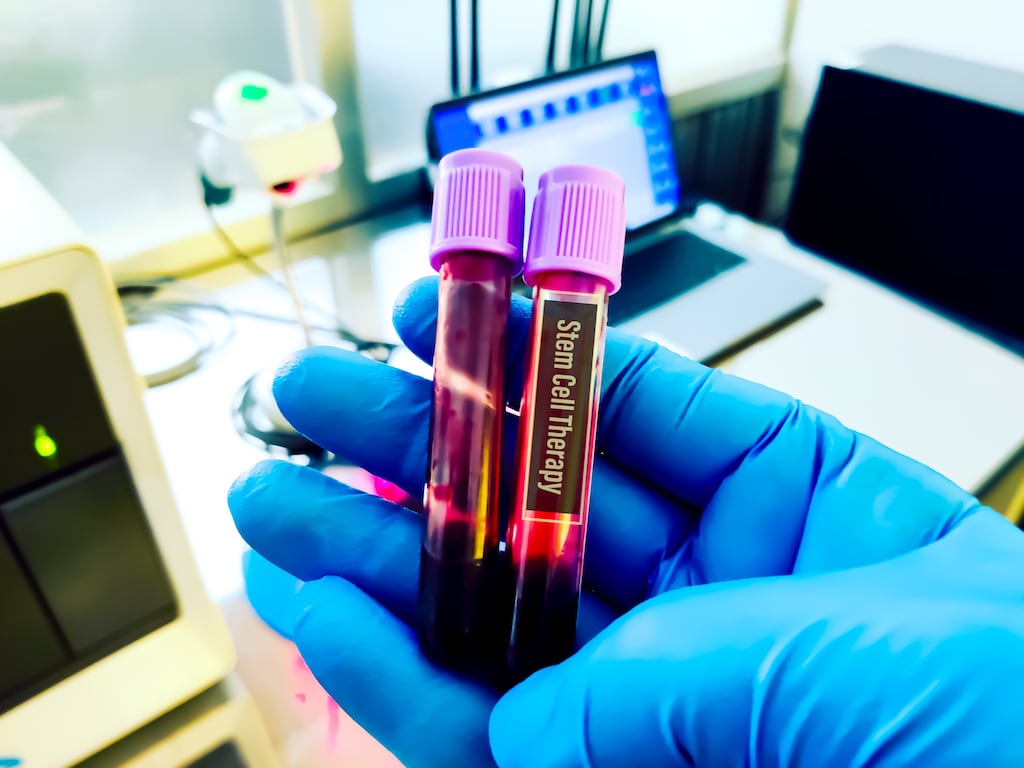
The HSE has been urged to re-establish a stem cell laboratory in Cork, which would not only save cancer patients from Munster having to travel to Dublin or Galway for treatment but also increase national capacity to treat cancers such as leukaemia, lymphoma and multiple myeloma.
Campaigner Mags McCarthy of the Irish Blood Cancer Patients advocacy group is due to meet members of the Oireachtas in Leinster House on Wednesday to make the case for re-establishing a stem cell laboratory at Cork University Hospital (CUH).
McCarthy told The Irish Times how the lack of stem cell treatment at CUH has meant patients from Munster must now either attend St James’s Hospital in Dublin or Galway University Hospital if they are to receive the treatment – which in some cases can be life extending, and, in others, life-saving.
“My own father Michael had to go to St James’s Hospital for treatment in June 2022,” said McCarthy. “He was an in-patient for six weeks and, after his discharge, he had to stay close to the hospital in an apartment provided by the Leukaemia Trust for another six weeks because he had to be monitored closely.
READ MORE



“That was just in case he got an infection, because patients undergoing stem cell transplantation can have severely compromised immune systems, so he had to be nearby in case he had to be brought back into St James’s quickly because infections can be serious and, in some cases, life-threatening.”
The stem cell treatment worked for McCarthy’s father, and he is now in good health, but the experience made McCarthy aware of the challenges facing not just patients from Munster diagnosed with cancers but also their families as they face long and arduous journeys for treatment.
“These are people who are already seriously ill, but to access the specialist treatment that they need they have to travel to either Dublin or Galway and then spend weeks or even months away from their homes and families, so it takes a huge toll on both them and their families,” she said.
McCarthy, together with the president of European Society for Blood and Marrow Transplantation, Dr Ibrahim Yakoub Agha, will make the case at Leinster House for reopening a stem cell transplant unit at CUH – a move backed by clinicians at the Cork hospital.
CUH consultant haematologist Dr Vitaliy Mykytiv said that until 2006 CUH had been carrying out stem cell transplantation therapy at a laminar flow cabinet in the hospital, but new regulations required the therapy to be carried out in a full laboratory, so CUH was forced to stop.
[ Cancer rates rising more quickly among younger people, international study findsOpens in new window ]
Mykytiv said there were three types of stem cell therapy: autologous transplants where a patient receives their own cells; Car-T therapy where a patient’s own white blood cells are re-engineered to destroy cancer cells; and allogeneic transplants where a patient receives cells from a donor.
He said St James’s had 28 beds in its unit in Dublin and catered for patients receiving autologous, Car -T and allogeneic transplants, while Galway had five beds to cater for stem cell transplant patients but offered only autologous transplants and Car-T therapy.
“The main problem in Ireland is the lack of national capacity for allogeneic transplants and Car-T therapy,” he said. “If we were to open in Cork, what we would be looking to do would be autologous transplants – but that would free up allogeneic and Car-T capacity at both St James’s and Galway.”
Mykytiv said 89 patients of CUH, the Mercy University Hospital and the Bons Secours Hospital in Cork were attending either St James’s or Galway for treatment, which was a huge imposition on both the patients and their families.
He said it was a sad reality that some people waiting for transplant would die before they had the opportunity to receive the treatment because there was insufficient capacity nationally to meet demand.
“We need to increase capacity, and one way would be to re-establish stem cell therapy in Cork. At the moment Ireland is doing around 50 transplants per one million population, whereas Germany is doing around 95 transplants per million, so our transplant rate is very poor, it needs to improve.”