
Before she was born, Aileen Convery had been made a member of a pool that had not yet been built.
Her family was one of many in the local community to contribute to the Glenalbyn pool’s construction in Stillorgan on the southside of Dublin, granting them “founding membership”.
It was here where she learned to swim at the age of four, ultimately leading her to compete for Ireland in the 1988 Olympics in Seoul.
Although the pool was instrumental in her swimming career, the 56-year-old recalls it not being primarily competitive but “more about family” and a “special” place where a close-knit community gathered regularly.
READ MORE


“It was set up much more as a community space. The women on the cash desk would know all about your business,” she says, laughing.
The pool closed unexpectedly 12 years ago due to storm damage to the roof. The ruins of Glenalbyn make for a sorry picture today.
Boards cover the windows and doors of the reception area and changing rooms. Metal fencing blocks access to the now roofless swimming pool. Rotting timber is stockpiled against a wall.
The pool was not like this in its heyday.
People, young and old, in at least six swimming clubs, water polo and scuba diving clubs did not just swim; they met and made friends. Floor-to-ceiling glass windows were festooned with notices for clubs, competitions and social events.
Looking at the derelict pool now, it is hard to recall that Glenalbyn was once the hub of a vibrant swimming community.
Convery, a physiotherapist now living in Castleknock, west Dublin, found herself at the pool recently while her daughter was playing a match at the nearby GAA pitch.
“It just looks so sad,” she says.
Campaigns over the years to reopen the pool have faded away.
“I think hope has just been lost,” says Linda Clarke, who joined the Glenalbyn Swimming Club when she was seven.
Recalling the pool “essentially closing overnight” in 2013, Clarke, who swam the English Channel and around Manhattan in recent years, was, along with other regulars at Glenalbyn, left “devastated” by its closure.
The 51-year-old from Blackrock pauses briefly after her voice cracks while saying she frequently passes the pool.
What has been left behind is an “eyesore”, she says.
Thelma Jones described Glenalbyn as a “lifeline” when she moved to Dublin from Cork in 1996. “It meant everything: I had exercise, friends and a real community, and they took it away. I’m still furious,” says Jones.
Its closure “really affected our lives, and our whole sense of living. It was absolutely scandalous.”

Living in Churchtown on Dublin’s southside, the retired PE teacher and guidance counsellor now swims in Loughlinstown, about 7km south of Glenalbyn, but believes many gave up swimming after its closure.
Others, particularly those older in age, may have suffered a more social loss, the 69-year-old believes.
When it closed, campaigners pushing for Glenalbyn to reopen claimed the 47-year-old pool accounted for up to 34 per cent of visits to public pools in the Dún Laoghaire-Rathdown area.
The reopening became a local issue in the 2016 general election, championed by local TD Shane Ross. Despite councillors voting to ringfence €10 million in their capital budget for the project, it never reopened.
Dún Laoghaire-Rathdown County Council says a new complex with two pools for children and adults is to be built at the Samuel Beckett Civic Complex in Ballyogan, about 6km south of Glenalbyn.
The council has been awarded a €5.65 million grant for the project under the Government’s Large Scale Sport Infrastructure Fund, which was set up to fund larger sports facility projects such as stadiums, club houses and swimming pools.
The fund is, according to Swim Ireland, vastly over-subscribed.

The country’s network of swimming pools is ageing.
A report published by Swim Ireland last December said that at least a quarter of the swimming pools in the State are more than 35 years old and coming to the end of their lifespan. The report said that just 2.5 per cent of public pools were built in the last five years.
Evidence of this decline is not hard to find.
In Coolock, Dublin, the city council pool has experienced difficulties that echo what happened in Glenalbyn. The roof was severely damaged by storms, forcing the council to shut the pool immediately for safety reasons.
This month council officials said they were exploring a plan to open an alternative pool at the Kilmore Recreation Centre at an estimated cost of €5.5 million.
In north Co Dublin, the Portmarnock Sports and Leisure Club said “a maintenance concern with the roof” forced the closure of the pool and sauna.
The Markievicz Leisure Centre, which houses a pool on Townsend Street in Dublin 2, is to be demolished to make way for the MetroLink rail line running north to Dublin Airport and beyond. A larger facility is planned as part of a new leisure centre at Irishtown Stadium, but a key city centre swimming amenity is to be lost.
In early 2021, Marian College Pool in Ballsbridge, Dublin, announced its permanent closure, citing the Covid-19 pandemic restrictions and related costs.
Difficulties with ageing pools extend across the State. A fire in January 2024 led to the closure and demolition of the public swimming pool in Edenderry, Co Offaly.
“It was a savage blow,” says Noel Cribbin, chairman of the council’s Edenderry pool committee, noting that 19 schools across Offaly and surrounding counties used the pool on a regular basis.
The council is planning a new pool in the town, costing about €15 million, with €8.9 million coming from the Large Scale Sport Infrastructure Fund.
Concerns over the structural integrity of the Buncrana leisure centre and swimming pool in Co Donegal led to its closure in 2015. In 2024, plans for a new pool were refused funding under the Large Scale Sport Infrastructure Fund.
A year later, local Fianna Fáil TD and Government Minister Charlie McConalogue announced up to €2 million would be made available to complete detailed design work on a new pool, but there is no available date for its opening.
The public swimming pool in Mallow, Co Cork, closed in March 2025 to undergo upgrades, including new changing rooms, energy-efficiency improvements and a new reception area.
Although the work was originally due to be completed in January, unforeseen structural and ground issues have pushed the reopening to June, Cork County Council said.
There is no 50m swimming pool – the international Olympic-standard size – in Cork, south Munster or all of Connacht. Athletes must travel up to 130km from east Cork or more than 200km from Sligo to the University of Limerick’s pool to train.
The swimming pool at Ferryhouse Sports Complex near Clonmel, Co Tipperary, has been out of operation since January 2025, declared unsafe due to mechanical and electrical issues.
Tipperary South TD Michael Murphy says the swimming pool “was far more than a recreational amenity” for some 500 children who used it each week.
“For decades, it has brought children, families and local swimming clubs together in a healthy and positive space,” he says.
There are no plans to repair and reopen it.
Mary McMorrow, interim chief executive of Swim Ireland, says the “shocking” reality was that 57 per cent of swimming pools in Ireland are now provided by hotels.
She gave Galway as an example; the city has 11 swimming pools, she says, but only one is a local authority pool.
Although she says Swim Ireland was grateful for the availability of hotel pools, the situation masked “true shortages”. She says just 28 per cent of hotel pools included a hoist for people with disabilities. Another factor was that 93 per cent of hotel facilities offer membership options, but only 58 per cent offer pay-as-you-go use.
McMorrow says Government policies on active ageing, healthy living and the Sports Action Plan all indicated that swimming was a national priority, but the Republic has just one public pool for every 81,053 people compared with Scotland’s one pool for every 14,047 people.
“Swimming, cycling, running and walking are priority sports because of their ability to sustain physical activity into old age. But the level of investment doesn’t match this,” she says.
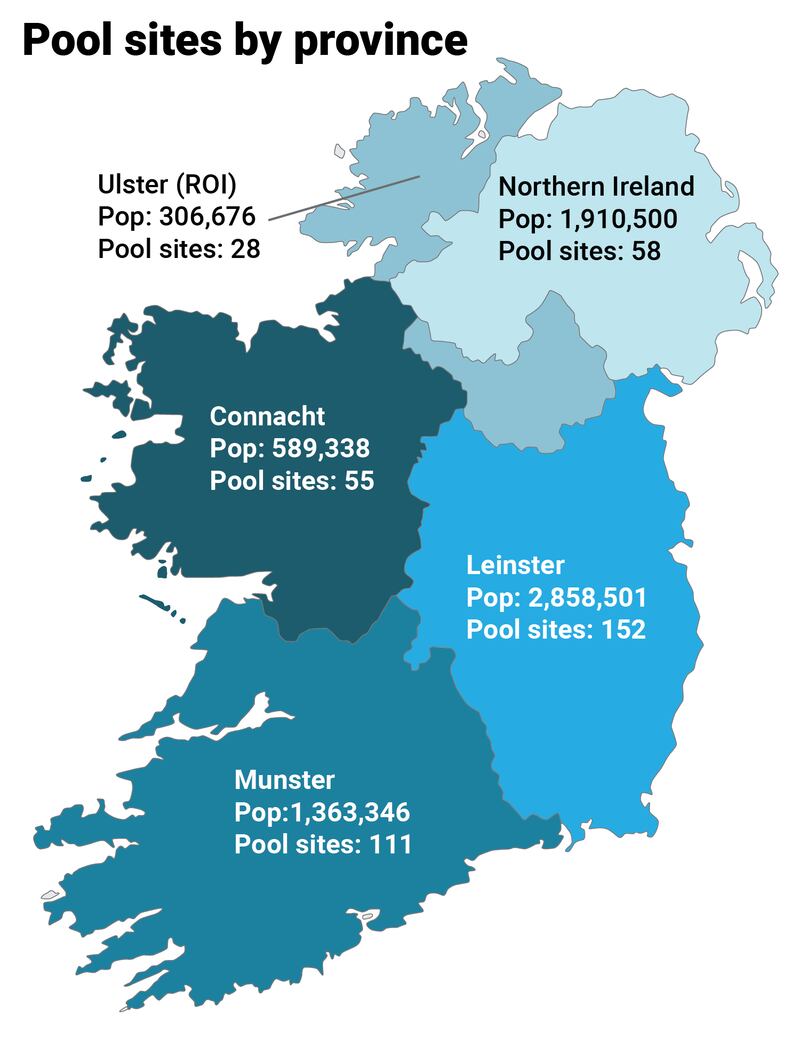
She has called for a new system of local authority swimming pool grants, potentially advancing projects with uniform design and costs.
Two-time Olympian Mona McSharry, the bronze medal winner in the 100m breaststroke at the 2024 Paris Olympics, joined – at the age of seven – Marlin’s Swim Club in Ballyshannon, Co Donegal, which has a 25m pool rather than an Olympic-size 50m pool. It was a 25-minute drive from her home.
“I would only know my own experiences, and I would say the Ballyshannon pool is one of the older ones. I wouldn’t say it’s the best pool ever, but it did well for me,” she says.
“I think going back there now, after training in Tennessee for five years, and having access to all the facilities over there, it would definitely be harder. But growing up I didn’t know any different, that was just the pool I trained in.”

Not having close access to an Olympic-size pool was a challenge.
“For me the hardest part about training in Ballyshannon was access to a long-course [50m pool]. The closest one was two hours away, the rest were all three. That’s probably where we’re missing out for a lot of younger swimmers, that they’re not getting access to long course,” she says.
“But at the same time, I trained in that Ballyshannon 25m pool until I was 20. Ellen Walshe is still training in her 25m pool in Terenure and she’s doing magnificent. So I think it’s more about mindset.
“I think just having access to a pool is more important, even if it is in a hotel.”
President Catherine Connolly, herself an active swimmer, expressed concern about the pace of Government investment in swimming pools.

In a Dáil question to Minister for Sport Patrick O’Donovan last June, the then Independent TD for Galway West asked how the Government “intends to fund and support municipal swimming pool construction”.
In his written reply, O’Donovan said there had been two rounds of Large Scale Sport Infrastructure Fund grants, in 2019 and 2024. He said his focus was on completing “project delivery” under these two rounds.
“This process will inform any decisions regarding the timing of a future round,” he said.
A spokesman for O’Donovan said last week that it was the Minister’s intention to introduce a new round of Large Scale Sport Infrastructure Funding in 2027.
Those who frequently swam at Glenalbyn in Stillorgan are not hopeful that the pool will be brought back into use.
“Not a chance,” says Thelma Jones. “It’s a disgrace. It makes my blood curdle,” she says, while the sight of the now derelict pool “breaks my heart”.
Linda Clarke, another regular, says the pool’s closure is “just incredibly sad” and had a far-reaching impact on some people’s lives.
“It left such a mark on the community,” she says. “Everybody looked out for each other and supported each other. It was the hub of the community.”
That community has “changed massively” since its closure, she says, and is now more dispersed, while some have “walked away from the sport”.


