

From Kharg Island in the Persian Gulf to Whiddy in Co Cork, the trickle-down effect of the Iranian oil crisis is starting to affect Ireland’s national oil reserve.
All EU countries are mandated by the International Energy Agency to maintain 90 days’ worth of national oil use in anticipation of a crisis.
Now, more than 90 days after the US-Israel war on Iran began, almost 200,000 tonnes of oil are being released from Ireland’s public reserves. That is the equivalent of 10 days of oil.
Five days worth of oil has already been released, with five more due to be released in the next six weeks. As a ceasefire hangs in the balance, how stable is Ireland’s long-term oil supply?
READ MORE




National oil reserves are considered a critical part of the national security infrastructure, with oil stored by governments to offer their countries a buffer in the event of a crisis.
In total, there are 26 oil-storage facilities in the Republic of Ireland, including a mix of public and industry-held oil across the country.
More than a third of the public reserve is stored on Whiddy Island, a small island off the coast of Bantry in Co Cork.
The island is surrounded by historic gun batteries from the 1800s, a first World War US airbase and, since the 1960s, one of the island’s largest oil terminals. It is still home to the wreckage of the Betelgeuse Incident, when a French oil tanker explosion killed 51 people in 1979.

Some of the country’s strategic reserves are also stored elsewhere in Europe in storage facilities in Spain, Sweden, Denmark and the Netherlands.
This is partly in preparation for a national crisis and partly because storage overseas is simply cheaper than building huge oil-storage tanks domestically.
Satellite analysts and traders often monitor oil reserves from above to assess how much they are holding by examining their shadows.
Most modern oil-storage sites have floating roofs that rise and fall as they empty and fill. A tank that is partially empty will form a crescent moon shadow inside the rim as the roof falls.
This can indicate a decrease in supply. However, it can also simply reflect the constant ebb and flow of commercial oil being consumed and replenished. Even oil in reserve, which has a lifespan of five to 10 years, needs to be regularly refreshed.
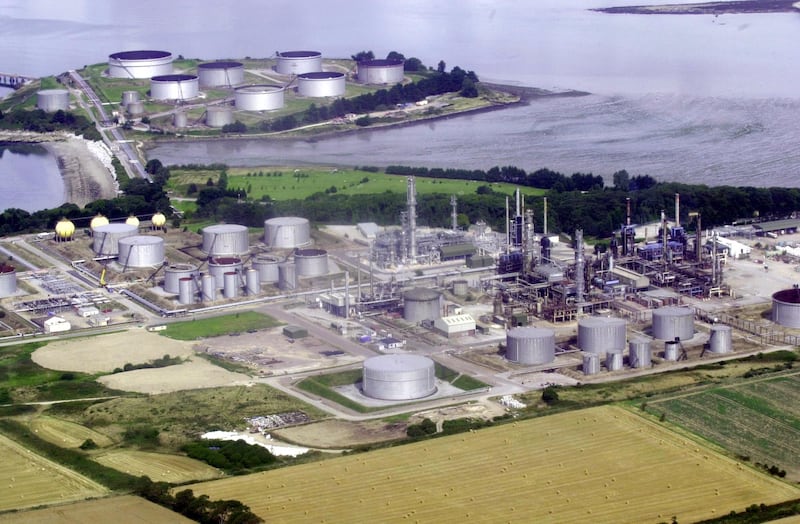
For example, at another oil-storage facility on Corkbeg Island near Cork Harbour, five of eight reservoir roofs were well below the top of the walls as of April 29th.
However, 11 days later, with the arrival of a new tanker on May 10th, the roofs rose as new oil flowed into the country.
By all metrics, oil is still flowing into Ireland.
Arrivals of oil tankers into Irish ports since the war began has continued at a similar pattern to the same period last year, an analysis of data from ship-tracking website Marine Traffic shows.
Corkbeg Island serves as both a dock point for crude oil tankers travelling from all over the world, as well as essential storage for the Whitegate refinery across the bay – Ireland’s only refinery.
Since the war began, Whitegate has received 54 oil tankers (including crude oil, oil product and oil/chemical tankers) as of May 28th. This compares to 56 in the same period last year, according to Marine Traffic data.
Dublin Port, the country’s largest port and home to multiple commercial storage facilities, received 101 oil tankers, up from 94 last year.
Foynes on the Shannon Estuary, Co Limerick, received 16 – the same as in 2025. Galway Port received nine, compared with eight last year.
Ireland does not receive oil direct from the Strait of Hormuz.
Some 93 per cent of oil tankers arriving in Ireland in the 90 days since the war began were last docked elsewhere in Europe, with 65 coming from the UK and 45 from the Netherlands, a major port destination.
Six per cent originated from North America and just one came from further afield in Tanzania.
According to the National Oil Reserves Agency (NORA), fuel consumption has not declined either, a key indicator of steady supply.
So why release the reserve?

The global supply is constrained by the blockade in the strait, where 25 per cent of the world’s seaborne oil trade passes through – 80 per cent of it bound for Asia.
The trickle-down effect of this traffic jam in the strait is pushing prices up worldwide.
As a result, the International Energy Agency (IEA), a global organisation that works with government and industry to ensure secure energy supply, has instructed its member countries to release part of their reserves.
The goal of the “largest ever oil stock release” is to help stabilise prices.
“On March 11th, the 32 member countries of the IEA unanimously agreed to make 400 million barrels of oil from their emergency reserves available to the market to address disruptions in oil markets stemming from the war in the Middle East,” a spokesperson for NORA told The Irish Times.
“NORA was instructed by the Minister for Climate, Energy and the Environment to release 1.61 million barrels of oil in support of the IEA’s action – this equates to circa 10 days of reserves.”
Five days’ worth of oil have now been released with another five to be released in the coming weeks.
The oil will be released back into the European market.
“Price will be the biggest longer-term concern,” said Aidan Meagher, co-head of geopolitical strategy at consultants EY Ireland.
“We think it will take 12 months for oil reserves to fill back up in terms of full supply,” Meagher said.
“LNG [liquefied natural gas] could be anywhere from one to five years.”
The longer the war goes on, the more prices will potentially rise.
Clionadh Raleigh, executive director of the Armed Conflict Location and Event Data Project (ACLED), a global conflict database, said there were no clear signs the war would end before September.
“If I thought this was going to finish before the end of the summer, I would see Israel taking a bigger step back from Lebanon. I would see steps toward normalisation on the Gulf side toward Israel and the US starting to remove threats from the region,” she said.
“None of those things are happening.”
With the war at a stalemate, the Strait of Hormuz could be opened, even if there is no wider peace plan, but there will be longer-term impacts beyond the blockade – with potential refinery damage from strikes and breakdown of Iran’s ability to produce oil.
“I’d be more worried that the longer the blockade goes on, Iran will have to shut down production so it can neither store or produce oil,” said Raleigh.
“Starting that back up again is no small feat.”


