
An Asian hornet, which poses a significant threat to Ireland’s biodiversity, has been captured by a member of the public in Co Cork.
Minister for Nature Christopher O’Sullivan called for renewed public vigilance following the discovery. The National Parks and Wildlife Service (NPWS) said a single nest of Asian hornets can “devastate” honeybee populations.
Hornets hover outside beehives like helicopters to ambush and snatch returning, tired forager bees.
The hornets immediately use powerful jaws to cut the heads and wings off captured bees. They then take the protein-rich thorax back to their nest to feed developing larvae.
READ MORE


The NPWS declared a biosecurity alert in August 2025 after capturing Ireland’s first invasive Asian hornet in Cork City, followed by the seizure of two active nests in the region.
The latest discovery occurred last week in the Ringaskiddy area. A member of the public photographed the hornet, captured it, and notified the National Biodiversity Data Centre.
The sighting triggered a rapid response plan led by the NPWS to investigate the possibility of any further activity in the area.
“It is important that we stay alert,” said O’Sullivan. “That’s why I am asking [people] to ... keep an eye out for Asian hornet activity in their gardens and other outdoor areas. Early detection is key if we are to prevent this species from gaining a foothold in Ireland and damaging our pollinators and ecosystems.”
The Asian hornet reporting system, which is managed by the National Biodiversity Data Centre, is available online at invasives.ie.
The National Museum of Ireland will now examine the recently captured specimen as scientists build their knowledge of the invasive species and the risk it poses.
While their venomous sting is painful, health authorities note they pose no greater direct risk to humans than native wasps or hornets, unless an individual suffers from severe allergic reactions.
The Asian hornet is distinguished from other hornets, wasps, and bees by its dark, velvety body, bright yellow leg tips, and specialised hunting behaviour.
It has a predominantly black or dark brown chest and abdomen, unlike native European hornets which feature prominent yellow-and-brown striped or mostly yellow abdomens.
The Asian hornet’s dark abdomen is marked by a single distinct orange-yellow band on the fourth segment.
Its legs are dark brown or black with distinct, bright yellow tips, whereas European hornets have reddish-brown legs and bees have hairy legs adapted for pollen.
Importantly, it features a bright orange face with dark markings on top, contrasting with the completely yellow face of the European hornet.
[ How to recognise an Asian hornet and what to do if you see oneOpens in new window ]
It is smaller than the native European hornet (workers are about 25–30mm long), making it closer in size to a large common wasp. Bees are generally hairier, fluffier, and smaller than hornets.
Unlike bees, which gather nectar and pollen, or general wasps which scavenge for sweets and varied insects, the Asian hornet exhibits a precise, stationary hovering flight directly in front of beehives to catch returning forager honeybees.
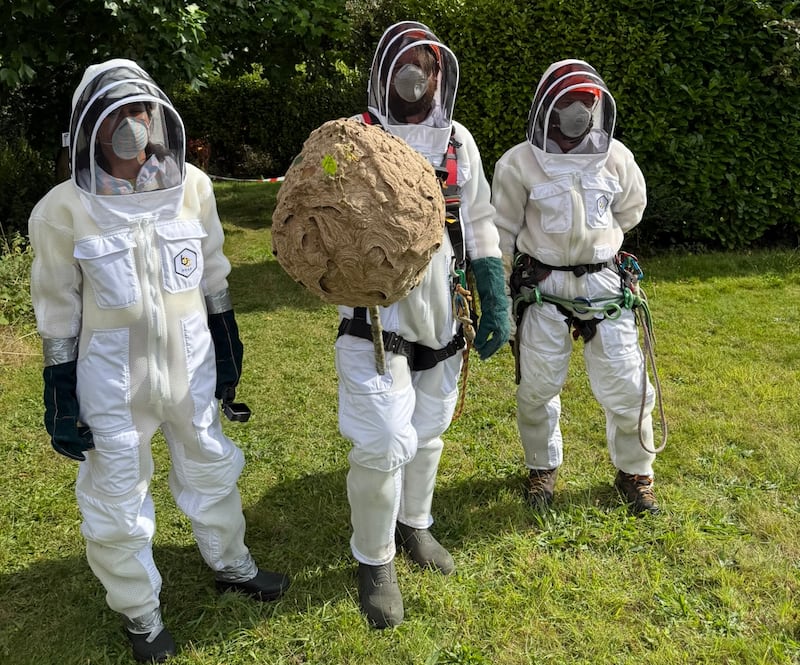
Asian hornets build large, spherical or pear-shaped papier-mâché nests often 15m to 20m high in tree canopies which can house thousands of workers by late summer.
The public has been encouraged to photograph sightings and report them to the National Biodiversity Data Centre.
Members of the public should not attempt to handle them. Widespread trapping is not recommended as they remain at a low level in Ireland.


