Main points
- European leaders met in Dublin today for an informal meeting of heads of state or government of the EU.
- The conflict in Ukraine dominated the European Political Community summit in the Convention Centre on Thursday, which was attended by almost 50 world leaders.
- A major security operation was in place, with roads around the Convention Centre closed to the public.
- A special “VIP escort” to Dublin Airport for an individual requiring specialist medical treatment abroad was carried out “at the height of the arrivals” of heads of state and government on Wednesday.
- European Commission president Ursula von der Leyen said the EU would be involved in Ukraine peace talks to “safeguard our interests”, as EU foreign policy chief Kaja Kallas suggested she should represent the bloc in such talks.
Key reads
- In pictures: the European Political Community summit
- Jack Power: Dublin becomes centre of Ukraine discussions as European leaders meet
- Dublin road closures: See full list of disruption
- Bobby McDonagh: The traffic chaos is temporary. What happens this week in Dublin could have lasting impact
Von der Leyen: Europe “must get AI right”
The President of the European Commission Ursula von der Leyen has described the two days of the Dublin summit as “intense”.
She thanked Professor Geoffrey Hinton for his briefing to EU leaders about the benefits and risks of AI.
“Every generation faces a technological turning point that shapes the decades ahead,” she said.
“For hours, it is artificial intelligence, and Europe must get it right.”
Europe needs “massive computing power” she said and also ready has 19 AI factories in Europe with seven more in planning.
This will involve €30 billion of investment throughout Europe.
Contrary to what many people believed, there are more AI start-ups in Europe than in the United States.
Europe will need €500 billion to ensure that AI start-ups can be scaled up to compete on a global stage.
EU to send team of negotiators to peace talks
The European’s “team” of negotiators will be a mix of officials from the bigger powers and the EU’s institutions, António Costa has told a press conference at the end of the summit, Jack Power reports.
Costa, the European Council president who chairs the leader’s top-level discussions, welcomed all diplomatic efforts to end the Ukraine war.
There was no decision to settle on a single European envoy, or representative in restarted talks.
Costa said a team of European negotiators would include people from the EU institutions, and the largest five European powers, known as the E5, which is France, Germany, the UK, Italy and Poland.
Russia’s strikes on civilians and cities indicated it wasn’t really serious about peace, Costa added.
Pressure must be kept up on Russia, says von der Leyen
President of the European Commission Ursula von der Leyen has set out Europe’s goals for any peace agreement between Russia and Ukraine.
There will need to be “robust and legally bind security guarantees” and a post-war prosperity package for Ukraine.
In the meantime, she said maximum pressure must be kept on Russia and a 22nd package of sanctions will short be agreed at the next European Council meeting.
That meeting will also address the funding gap for Ukraine which is estimated at €70 billion for next year. The EU will have to find approximately €45 billion to ensure that Ukraine is fully funded for next year.
“Let me clear, the path to peace will not be easy, but we will remain united as we have been over the last five years in our support for Ukraine and with the end goal clear in our minds.”
Von der Leyen says EU will be involved in Ukraine talks to ‘safeguard our interests’
The president of the European Commission Ursula von der Leyen has said Europe itself will decide who represents it at any talks in relation to the Ukraine-Russian war.
Von der Leyen did not say who would actually represent the EU at any multilateral talks to end the war, but she gave a robust defence of Europe’s support for Ukraine.
EU foreign policy chief Kaja Kallas said she wants to represent Europe in negotiations with Russia, though the Russians might reject her role as a negotiator given her harsh criticism of the country.
On arriving in Dublin, US negotiator Jared Kushner pondered as to who would represent Europe at any future talks.
“Since five years, we have been united steadfast by the side of Ukraine from day one on and we are still at the side of Ukraine,” von der Leyen said at the closing press conference.
“We will stand by Ukraine until we have a just and lasting peace.”
Von der Leyen said Europe had already given €230 billion in direct support to Ukraine but also material and military support, and was there entitled to be part of any peace settlement.
“In relation to the negotiations, it is clear why we will be there. We want to safeguard our interests and we want to support Ukraine.”
Ukraine and AI dominate final press conference
The European summit has wrapped up with a press conference hosted by Taoiseach Micheál Martin, the President of the European Commission Ursula von der Leyen and European Council president Antonio Costa.
The press conference had two themes - Ukraine and artificial intelligence (AI).
EU leaders had been addressed by Professor Geoffrey Hinton, the British-Canadian Nobel Prize winner known for developing artificial neural networks who warned that AI could have catastrophic impacts on mankind if it is not regulated.
Farmers protest outside the Dublin Convention Centre
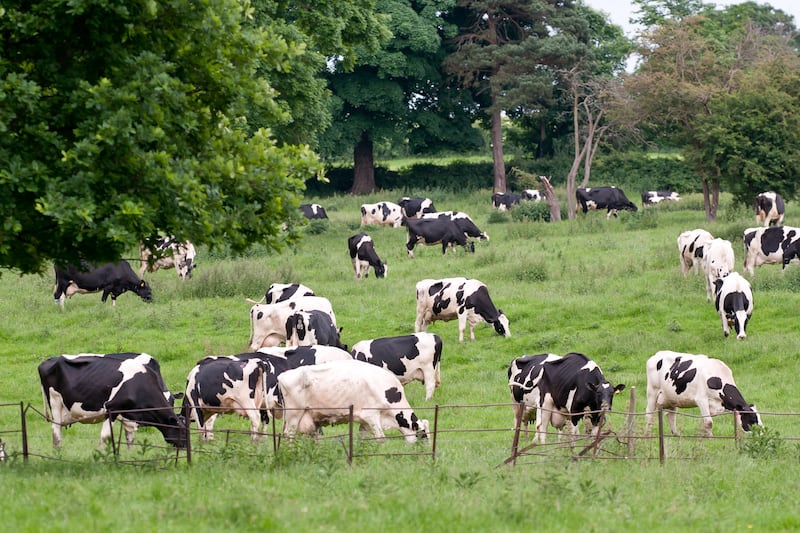
Hundreds of farmers are gathering right across from the Convention Centre to protest planned cuts to the Common Agricultural Policy (CAP).
The €2 billion multi annual financial framework (MFF) is currently in play and there are fears that the renegotiated CAP will threaten the viability of smaller farms.
The Irish Farmers Association and Copa-Cogeca, the umbrella organisation for farm representative bodies, demonstrated beside Beckett Bridge.
They posted on X: “From Ireland to every corner of the EU, the farming sector is standing together at this decisive moment of the MFF negotiations.
“Europe cannot defend its future by cutting the budget of its first line of defence: the Common Agricultural Policy.
“We call on heads of state and government to deliver a strong, common and well-funded CAP, a budget at least maintained and adjusted for inflation.”
Summit comes to a conclusion
The summit has wrapped up after three days at the Convention Centre in Dublin.
There will be a press conference shortly where we will hear from Taoiseach Micheál Martin, the President of the European Commission Ursula von der Leyen and European Council president António Costa.
EU security architecture not up for negotiations, says Merz
EU leaders said on Friday that Europe’s security structure should not be a subject for Ukraine-Russia peace negotiations, but they did not answer the question of who should speak for Europe in any future talks.
The Kremlin said on Friday that Russia would be open to European countries taking part in Ukraine peace talks if it saw they were ready to contribute to the peace process.
German Chancellor Friedrich Merz described the Kremlin’s comments as “the same old game” and said that Europe and the United States agreed on a clear message.
“There will be no discussions about Ukraine without Ukraine, and no discussions about Europe without Europe. Furthermore, there is no need to talk about European security architecture. We have that already,” Merz told reporters during a summit of European Union leaders in Dublin.
Russian officials have called for a broad agreement on Europe’s security architecture to be reached before tackling the specifics of the war.
Before its invasion of Ukraine in 2022, Russia demanded the withdrawal of Nato forces from countries that joined the alliance after 1997. Nato rejected the demand.
EU foreign policy chief Kaja Kallas said Russian calls for discussions about Europe’s security architecture risked diverting attention from the need for a ceasefire. Latvian Prime Minister Andris Kulbergs called such discussions “a trap” - Reuters
Latvian PM urges Europe to ‘grow some bigger balls’
Latvian prime minister Andris Kulbergs used some undiplomatic language at the informal EU summit in Dublin.
“We, as Europe, have to grow some bigger balls,” he told reporters on Friday.
“We are bigger in size, we are bigger in military might, in all the economic aspects. Look where is Russia, Russia is not capable of even taking a smaller power as Ukraine, which is showing a great spirit in fighting back [for a] fifth year.”
Russia is in no position to make demands, he explained, and in fact, “We are the guarantee for the future security, it is our geographical area [which] is in the future with Ukraine and so I think that should be the position in the discussions.”
Russia makes big demands as price for ending war
Germany’s biggest newspaper Bild is reporting Russia’s maximalist demands for the forthcoming peace talks.
Russia is demanding that Finland leave Nato. Finland, which has historically been a neutral country until Russia invaded Ukraine in 2022, joined Nato in 2023.
Russia has always called for no Nato bases in the Baltic states and no European troops in Ukraine.
It further wants Moldova, which has a desire to be an EU state, federalised with a referendum in Transnistria
It also wants to keep the occupied territories it currently holds in Ukraine and the whole of the Donbas which has it has failed to conquer in 12 years.
The demands were made at the Abu Dhabi talks which ended without agreement.
Ukraine continues to hit Russian refineries
While talks of a peace breakthrough continue at the EU leaders summit, Ukraine has hit more Russian oil refineries.
It hit a major refinery in the Volga region on Friday after the latest round of US-mediated peace talks between the two nations ended earlier this week.
Ukraine’s General Staff said in a Telegram statement that its forces attacked Lukoil PJSC’s Volgograd refinery overnight, causing a fire. The plant’s four primary processing units, a hydrotreatment unit, six storage tanks and a loading rack were damaged, according to the statement.
The Volgograd refinery is located about 900 kilometres southeast of Moscow, and has a nameplate processing capacity of about 300,000 barrels of crude a day.
The latest strike means that since the start of November, Ukraine has attacked nine Russian oil refineries.
Belarus president-elect calls for her country to be involved in negotiations
One of the non-EU leaders who has been prominent at the summit is the president-elect of Belarus Sviatlana Tsikhanouskaya.
Tsikhanouskaya has called for the status of Belarus to be included in any Russia-Ukraine peace negotiations.
Belarus was used as a base for Russian troops to invade Ukraine.
“Without a free and democratic Belarus, there will be no security, neither for Ukraine nor for European countries,” Tsikhanouskaya said.
Meeting between Zelenskiy and US envoys came at ‘short notice’, Garda Commissoner says
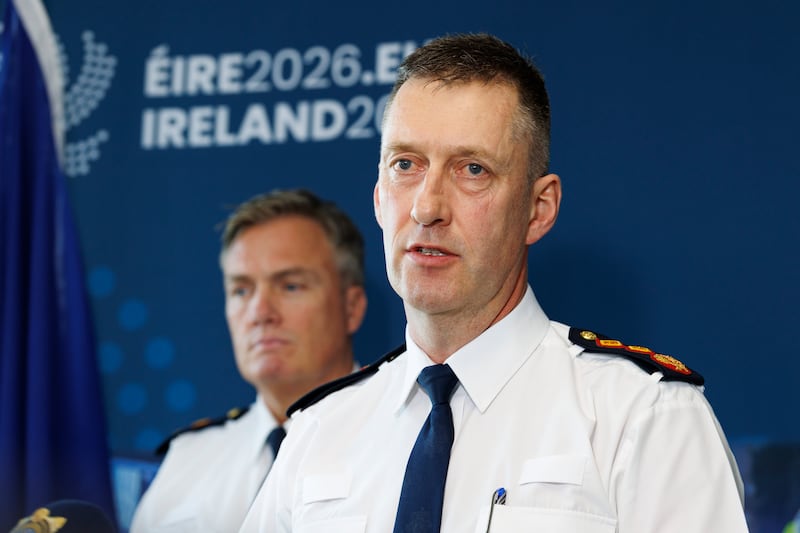
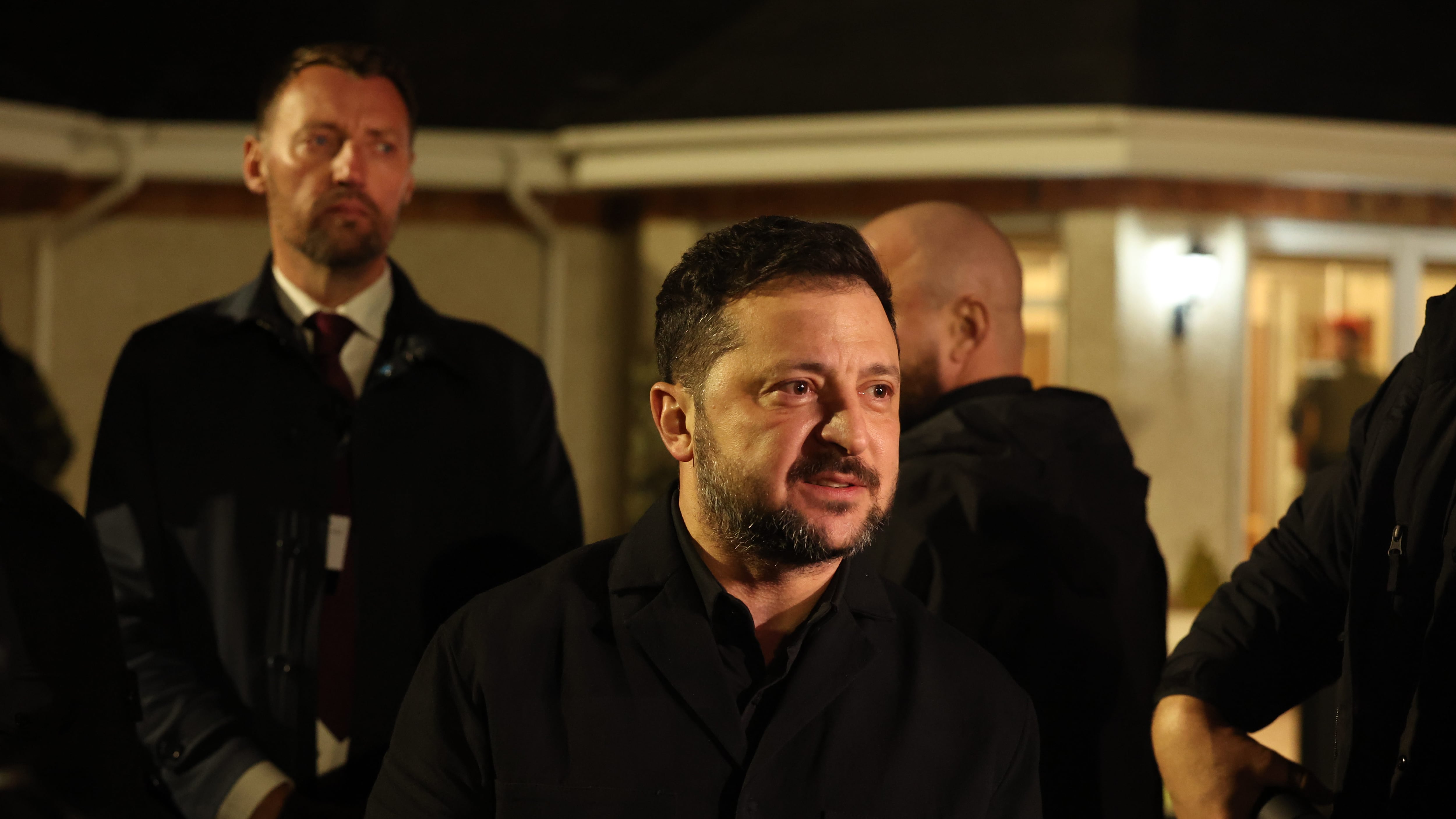
A rapid-reaction security force was assembled and put in place to secure a meeting in Dublin between Ukrainian president Volodymyr Zelenskiy and US envoys on Thursday night.
Garda and Defence Forces sniper teams, as well as anti-drone professionals, worked alongside US and Ukrainian security personnel.
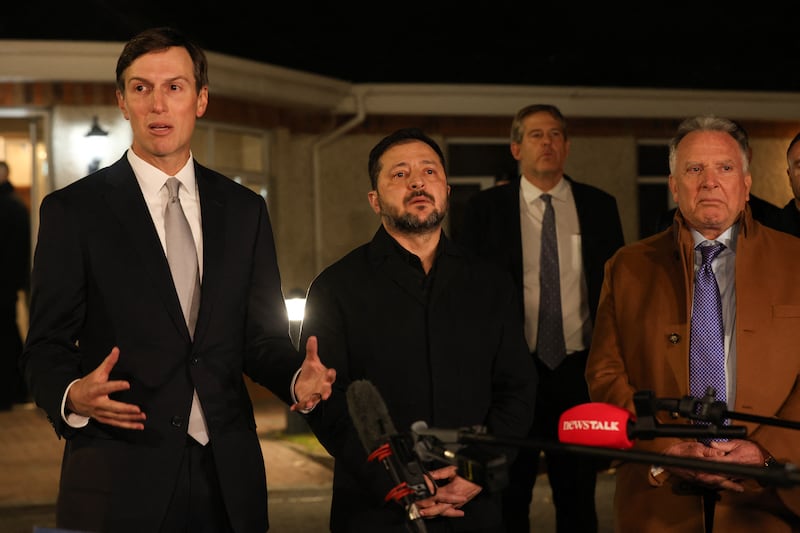
The meeting, which took place at short notice at the Air Corps Casement Aerodrome in Baldonnel, was between Zelenskiy and US envoys Jared Kushner and Steve Witkoff.
Garda Commissioner Justin Kelly said 200 Garda personnel were on anti-drone duties, and had equipment capable of taking drones out of the skies. Some were diverted to Baldonnel for the US-Ukraine meeting, which was not known about in advance, while the Defence Forces also had an anti-drone capability on site.
“It came at very short notice, we weren’t aware of it,” Kelly said of the meeting.
Read more from Security and Crime Editor Conor Lally here.
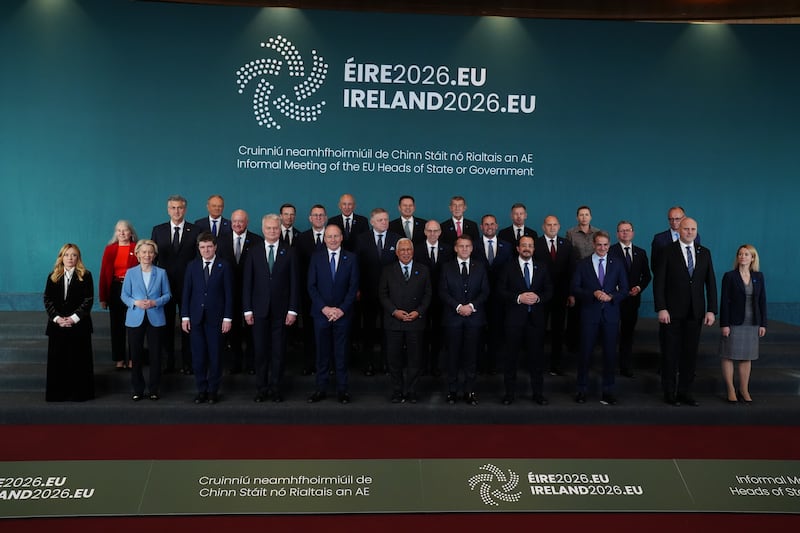
Some “family photos” from today’s summit are coming in from our photographer Alan Betson.
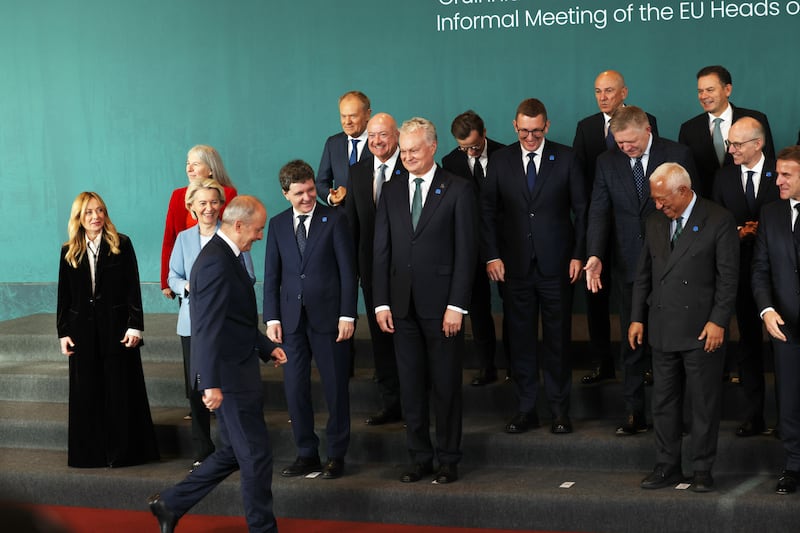
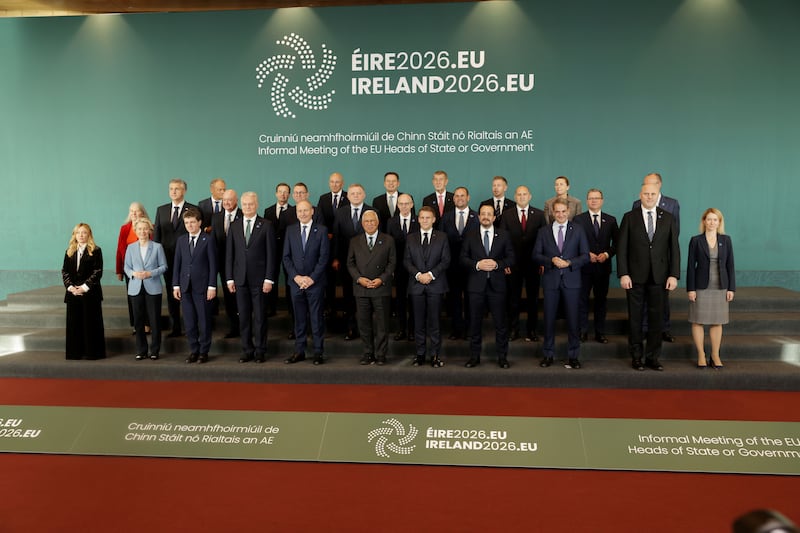
Hungary’s prime minister Péter Magyar poured a pint of Guinness in Dublin after Thursday’s European Political Community summit.
German chancellor wants ‘no surprises’ from US in Putin talks
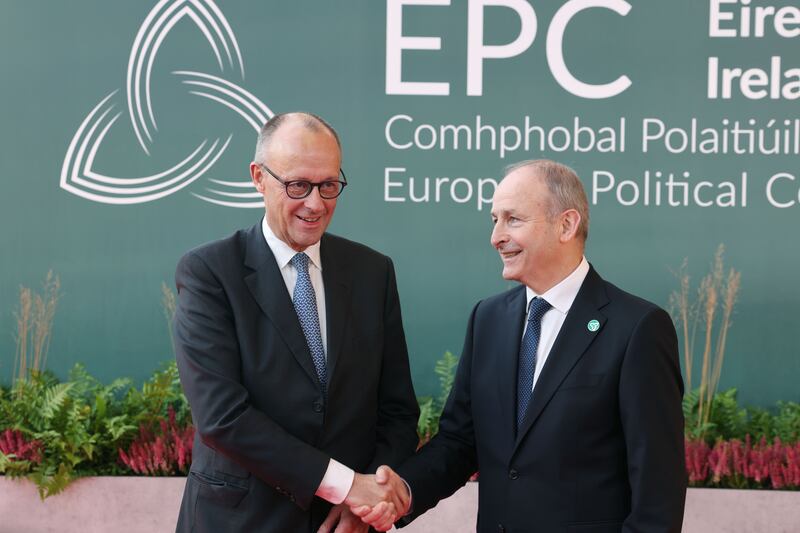
German chancellor Friedrich Merz has pleaded for US president Donald Trump to create “no surprises” during expected talks about Ukraine next week with Russian president Vladimir Putin in China.
“Some here in Dublin fear this could turn into a ‘second Anchorage moment’,” said Merz on the sidelines of Friday’s meeting of EU leaders.
“I therefore want to state our message to the United States very clearly: please, no surprises. Continue to play as part of ‘Team Europe’ and ‘Team Ukraine’.” - Reuters
Individual required ‘time-critical’ medical transfer abroad on Wednesday
A special “VIP escort” to Dublin Airport for an individual requiring specialist medical treatment abroad was carried out “at the height of the arrivals” of heads of state and government on Wednesday.
In a statement on Friday, An Garda Síochána said it assisted in the “time-critical medical transfer”, which saw an individual transported to the UK for treatment.
The incident, which occurred as leaders were arriving for the European Political Community (EPC) summit, was managed from the Dublin regional control centre and involved a multi-agency response.
An ambulance was dispatched to collect the individual and was met and escorted “across the country” by gardaí.
“Despite the demands for EPC-related escorts in the Dublin region, a national escort motorcycle team was diverted to meet the medical escort approaching Dublin and complete this VIP escort to Dublin Airport,” the Garda said.
On arrival at Dublin Airport, the individual was transferred to a waiting HSE private air transport service which brought them to the UK.
“From first phone call the patient arrived at the required medical facility in the UK within 4 hours, well within the target window for treatment,” the Garda said.
Kallas suggests she should speak for Europe in Ukraine peace talks

The EU’s top foreign policy official Kaja Kallas has suggested that she should be the European voice at negotiations between Russia and Ukraine.
Following a meeting last night between Jared Kushner and Steve Witkoff, and Volodymyr Zelenskiy, in which Donald Trump’s envoys said a European delegate will join the next round of peace talks, Kallas said she is mandated to be the one at those negotiations.
“In 2024, in June, there was a decision by the leaders, who is representing us when it comes to security and foreign policy, and it was the discussion that in these five years there’s going to be a negotiation with Russians. So, if the leaders want to change that agreement, of course they may because it’s the leaders’ decision,” she said.
Kallas added that “all the member states actually agreed that I’m the one who is representing Europe in foreign and security policy”.
The former Estonian prime minister also believed Russia does not want her at the talks.
“I know that the Russians don’t want me, but do we have a say who is representing Russia? No, we don’t, and really we have to have a strong team,” she said.
“They don’t want anybody strong on the other side because they want to push through their maximum demands, like they have always done. - PA
Russia open to European countries taking part in peace talks
Russia would be open to European countries taking part in Ukraine peace talks if it saw that they were ready to contribute to the peace process, the Kremlin said on Friday.
The comment suggests Russia has not yet committed to including Europeans in the next round of talks, despite US negotiators saying on Thursday that president Vladimir Putin had agreed to their participation.
Asked if negotiations would resume in the near future with European representatives joining those from Ukraine, Russia and the US, Kremlin spokesman Dmitry Peskov told reporters:
“Once we understand their genuine intention and readiness to contribute to the peace process, then it will be possible to make a decision on holding dialogue on a Ukrainian settlement in an expanded format.” - Reuters
US envoys gave direct assurances Europe can join Ukraine peace talks

Jared Kushner and Steve Witkoff gave direct assurances to senior European security officials that they can join the next round of Ukraine peace talks during a meeting in Baldonnel last night.
Europe Correspondent Jack Power has gleaned some details from the shuttle diplomacy that played out at the Dublin military airbase yesterday.
It is understood that after Ukrainian president Volodymyr Zelenskiy sat down with Trump’s envoys, Kushner and Witkoff then held a meeting with several senior officials from Europe’s big military powers.
France, Germany, the UK, Italy and Poland had people in the room. Ursula von der Leyen’s top adviser Bjoern Seibert joined as well.
The Europeans had travelled to Abu Dhabi earlier in the week as well, where they held discussions on the margins with the US envoys and the Ukrainians, but weren’t invited to join the “trilateral” talks involving Ukraine, Russia and US negotiators.
The discussion between the US envoys and European officials in Dublin gave a clear commitment that Europe would have a seat at the table in the next round of negotiations about a settlement ending the Ukraine war. The talks will shift from a trilateral to a “multilateral” format. Though whether that’s a permanent shift is an open question.
The date of that meeting will be fixed soon, but we don’t expect to have it set before European countries who make up the “coalition of the willing” supporting Ukraine meet in Berlin next Thursday.
European leaders are still some distance apart on the idea of appointing a single representative or negotiator to speak for the EU, or the wider Continent’s interests in the negotiations.
The informal meeting of the 27 EU leaders is currently under way.
Today’s talks will focus on AI and the Ukraine war.
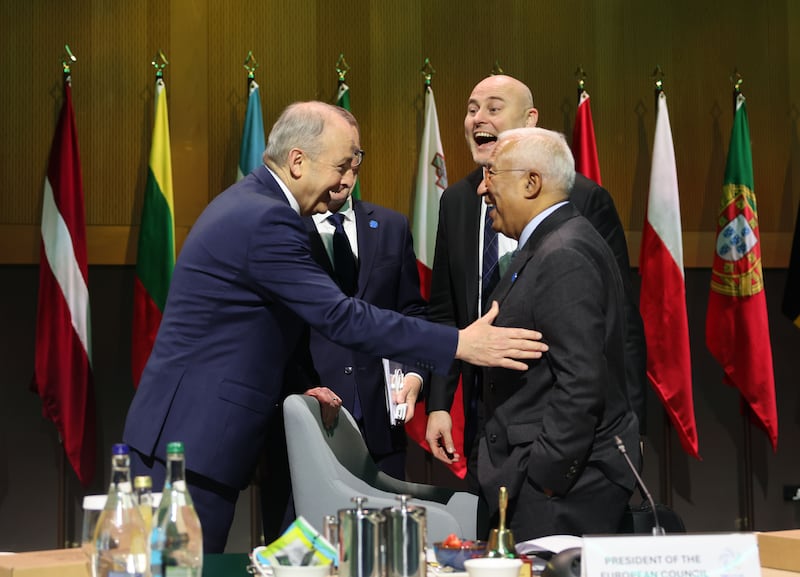
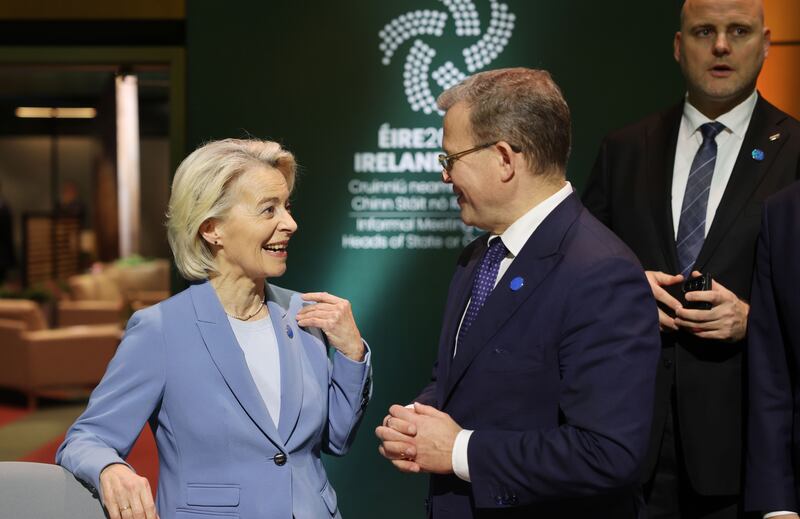
A bit of EU summit trivia from Jack Power:
There will be one prime minister in the room speaking for three countries on Friday.
Luxembourg’s man, Luc Frieden, is also representing the Netherlands and Belgium.
Dutch prime minister Rob Jetten couldn’t make the Dublin trip. He had to stay home for emergency talks to prevent the collapse of his minority centrist coalition.
Belgium’s Bart De Wever also sent his apologies as he’s locked in make-or-break budget talks with his coalition colleagues.
There’s a convention that when a leader can’t attend an EU summit they will nominate another head of government to speak for them. There’s no subs at this level, meaning a deputy prime minister can’t step in.
That’s why Frieden will be making the talking points for all three of the Benelux countries.
Summit not impacted by Microsoft outage
There’s no sense that the global Microsoft outage is causing major headaches for the EU summit, Jack Power writes. The leaders are set to spend the day locked in talks that maybe ironically will cover tech policy, specifically AI, its risks and opportunities, as well as the Ukraine war.
The meeting in Dublin is what’s known as an “informal” European Council, which means no decisions are taken. Think of it as a bit of a brainstorming session. So the prime ministers and presidents shouldn’t be checking their emails anyway.
Europe should not ‘walk into traps Russia is setting’, Kallas says

EU foreign policy chief Kaja Kallas has warned against the EU agreeing to Russia’s proposed sequence of talks on Ukraine, saying it would allow Moscow to “divert the attention away” from its actions and ultimately leave Europe “in a worse place”.
She welcomed the US side “finally admitting what I said already one and a half years ago – that for any deal between Russia and Ukraine … you also need the Europeans".
“I hope that we are just not at the table, but we are actually also really influencing the outcome of these negotiations,” Kallas said in Dublin.
“The most important is that we keep to our agreement that first the ceasefire, then peace agreement and then any kind of other talks … when Russia is still presenting their maximum demands, then we should also stick to the maximum demands and start to negotiate from there."
Kallas warned there is a risk of Europeans “actually walking into the traps that Russia is setting” as Moscow is trying to “divert the attention away from that there is no ceasefire and actually [get us to] start to listen to their claims”. - The Guardian
Traffic diversions remain in place
Traffic seems to be moving relatively well in Dublin at present, despite a number of road closures and diversions in the city.
Many people are avoiding the city centre because of the diversions.
There are also some restrictions on routes near Casement Aerodrome in Baldonnel, ahead of leaders leaving the capital on Friday afternoon and evening.
A full list of traffic diversions can be read here.
Ireland could be involved in peacekeeping efforts in Ukraine
Martin also said Ireland would be prepared to be involved in any security guarantees for Ukraine after the war, though not on in “enforcement” or “deterrent” roles, Pat Leahy reports.
“We’re open to ceasefire monitoring, the peacekeeping dimension to it, not the enforcement side of it, or not a deterrent force,” he said.
“But rather on the side of, say you had a ceasefire along the lines of where the current conflict is, Ireland as peacekeepers would be willing to play our role in monitoring that peace and particularly a ceasefire line, or indeed in terms of any other civilian dimension to conflict resolution or to working on peace initiatives.”
Europe must decide who represents Continent in peace talks with US, Russia and Ukraine - Taoiseach

European leaders need to resolve the question of who represents the Continent in peace talks between the US, Russia and Ukraine, Taoiseach Micheal Martin has said at the start of today’s meeting of EU leaders in Dublin.
Leaders will discuss AI and Ukraine, and there will be focus on the approach to peace talks on the Ukraine conflict, following the admission by US negotiators that Europe should have a seat at the negotiating table, Political Editor Pat Leahy writes.
“I think this needs to be resolved,” Martin told reporters at the convention centre this morning.
“I would hope that today’s discussions would bring clarity around this. Obviously, this is an informal council, so there’s work to be done between now and the special council in two weeks’ time. But it needs to be, in my view, finally decided upon within the next week or two.”
Martin said the European representation needs to take account not just of the EU, but of the non-EU European countries such as the UK and Norway.
“I think that did emerge yesterday that the substance of any peace agreement is as important as who represents Europe, and Europe needs to be very clear in terms of what would constitute a sustainable peace for the continent well into the future,” he said.
Beef and salmon on the menu
World leaders had dinner at the National Gallery last night, but what was on the menu?
Chef Mark Moriarty led the team who designed and cooked the meal at the EPC Summit official dinner.
Moriarty told RTÉ’s Morning Ireland he and others spent “two or three months” planning the meal.
“The Taoiseach was very specific. In fact, it was to be three or four courses ... and it had to be all about just showcasing Irish provenance, sustainable ingredients ... So we just kept it simple, put the produce on the plate, let it do the speaking.”
The meal included wild smoked salmon from Co Cork, beef from Co Wicklow and 50/50 mashed potato (which is half potato, half butter and salt).
“I was able to speak to the likes of President Macron and Andy Burnham and Prince Albert,” Moriarty said.
”And the one thing I noticed was when they started asking for more mashed potatoes with the main course. I said, ‘I think we’re okay here, guys. I think they’re enjoying it out there.’"
Martin says Fianna Fáil leadership chatter is ‘rubbish’
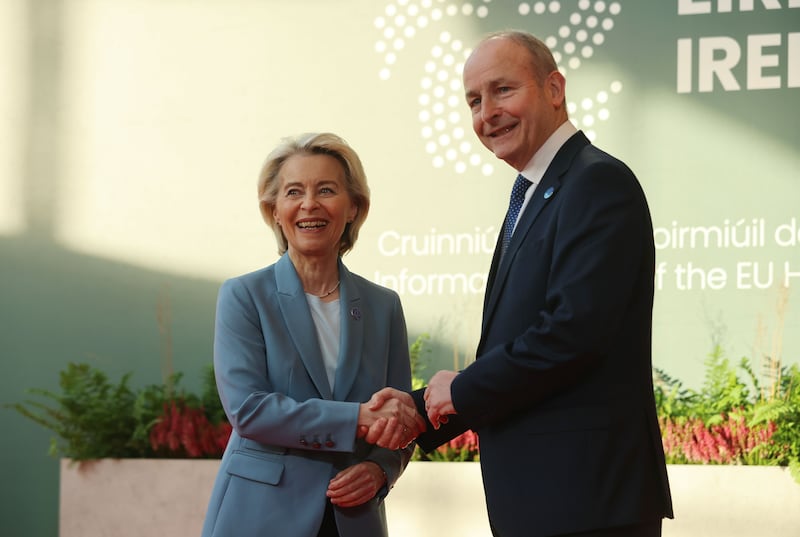
On the domestic front, Michéal Martin says chatter about him shifting stance on his desire to continue to lead Fianna Fáil is “rubbish”, reports Europe Correspondent Jack Power.
The backbench TD gossip mill was sent whirring into life yesterday when Martin answered a question on his leadership going forward on Morning Ireland. Some of his party colleagues felt he was a bit less definitive in setting out his intention to stay.
Martin sought to pour cold water on the speculation on Friday morning, saying: “I sent no signal … You’ve heard that talk of fulfilling mandates, and I will be contesting the next general election and will be leading Fianna Fáil into that election.“
‘No solid alternative’ to Europe holding talks with Russia over Ukraine
Alain Berset, secretary general of the Council of Europe, said he does not “see any solid alternative” to Europe being directly involved in negotiations with Russia to end the war in Ukraine.
Speaking on RTÉ’s Morning Ireland, he said: “It’s quite clear that we will never have peace and stability without [integrating] the whole continent. That’s just geography ...
“How can we prepare this long and lasting peace? Everybody is speaking about this. What does it mean exactly? It means that it will be not enough to have a ceasefire. We will need to have a reconstruction. We will need to have a stability and long-term stability, and this will be not possible without justice.”
Berset said the Council of Europe was helping to develop an “accountability mechanism” for crimes of aggression against Ukraine.
Ukraine has official EU candidate status since 2022, and accession negotiations having ramped up this year.
EU ‘can’t waste time’ deciding how to fund Ukraine
The Taoiseach says the EU can’t “waste as much time” before deciding how it would find €45 billion to shore up Ukraine’s budget next year.
Last December the EU’s leaders agreed for the first time to borrow money as a bloc to fund a €90 billion package for Ukraine.
Martin said it seemed likely they would take the same approach for the new funding shortfall.
“In my view … the loan option is the most effective one this time. That doesn’t mean that’s the way it’s going to be forever,” he said.
Europe Correspondent Jack Power looks at how the EU is relying on borrowing funds to keep Ukraine funded here.
EU leaders have started to gather at the convention centre in Dublin ahead of today’s informal meeting.
European security and efforts to end the war in Ukraine are set to dominate talks.
First European Council meeting happened in Dublin in 1975
A quick history lesson from Taoiseach Micheál Martin as he speaks to the media this morning, via Europe Correspondent Jack Power:
The first European Council - which is a meeting of the EU’s heads of government that sets the big picture political direction for the union - met in Dublin in 1975.
Now, 50 years later, Dublin is hosting an informal European Council summit today, as part of its EU presidency.

Micheál Martin had to greet 50 world leaders individually on Thursday, exuding warmth while respecting cultural and personal differences, writes Frank McNally.
Luckily, the Taoiseach’s repertoire of welcomes was extensive.
In the case of the Icelandic prime minister, for example, and despite her chilly-sounding name – Kristún Frostadóttir – he opted for the continental-style kiss on both cheeks.
But a minute later, when Liechtenstein’s PM Brigitte Hass arrived, there were no kisses – just a double hand clasp and lean-in, no less warm.
With Mark Carney, it was a businesslike, single handshake. And manual contact apart, perhaps surprisingly with a man who came to Dublin bearing the message that Canada was “moving closer to Europe”, there was clear daylight between the Canadian prime minister and Martin at all times.
US and Russia know Ukraine deal impossible without Europe, Taoiseach says
Washington and Moscow both know there can be no peace agreement or settlement ending the war in Ukraine without the input of Europe, Taoiseach Micheál Martin has said.
The terms of any ceasefire would have ramifications for the wider Continent, beyond states in the European Union, Martin told a press conference following the EPC summit in Dublin.
European Council president António Costa echoed these sentiments, saying: “Russia continues to be focused on escalating the war, it has yet to demonstrate it prioritises peace over dominance.”
The idea of strong powers establishing zones of influence over different corners of the world was something that belonged in the “dustbin of history”, Costa said.
Turning to negotiations concerning the Ukraine war, he said the future of European security “cannot be discussed and decided without Europe”.
Read the full report from Political Editor Pat Leahy and Europe Correspondent Jack Power here.
Traffic restrictions

Traffic restrictions remain in place in parts of Dublin city.
A security zone around the convention centre will remain in place until Friday evening with no cycling, walking or vehicular access permitted.
North Wall Quay between Guild Street and New Wapping Street will be closed to traffic and pedestrians until Friday evening, with east/west traffic being diverted from approach roads.
A traffic management cordon near the convention centre will be also be in place until Friday evening, involving the closure of Samuel Beckett Bridge and restrictions in the north inner city between Sheriff Street, Amiens Street, East Wall Road and North Wall Quay.
Luas Red Line trams will operate between Tallaght/Saggart and Connolly only on Friday. There will be no trams between Connolly and The Point. Normal Luas Red Line service will resume on Saturday.
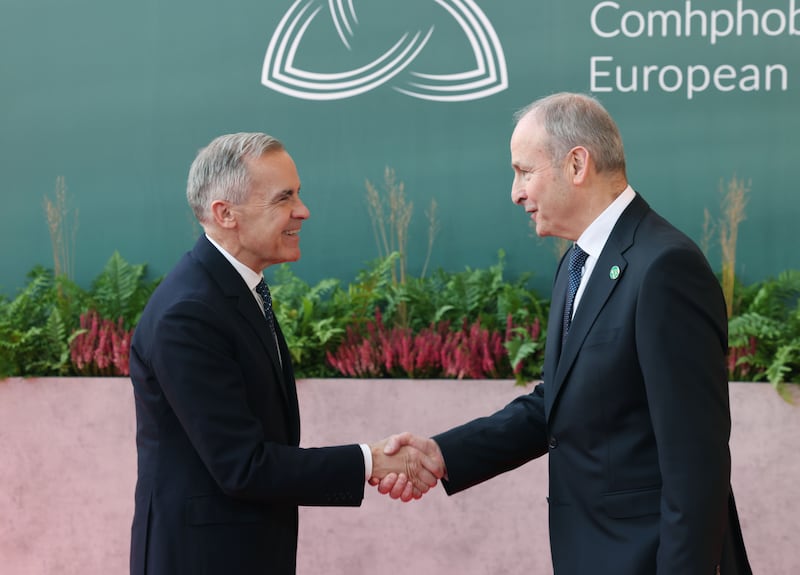
On Thursday, Taoiseach Micheál Martin welcomed European leaders as well as Canadian prime minister Mark Carney and the heads of international organisations such as Nato and the EU.
The Taoiseach also held a series of bilateral meetings, including with British prime minister Andy Burnham over the course of the day.
No sign of breakthrough in Ukraine talks
There was little sign of a breakthrough in ongoing efforts to reach a peace deal in Ukraine.
After the meeting in Baldonnel, Kushner said the US side had argued for the Europeans to be included in the negotiations. Witkoff said they were working hard on behalf of US president Donald Trump to being an end to the war, but gave no detail on any progress made.
“Our soldiers will come home and I am very thankful to all our negotiators. This is a real result, this is very important,” Zelenskiy said.
He said the American side made progress on talks with Putin on Europeans taking part in future talks.
Taoiseach to host informal meeting of EU leaders
Taoiseach Micheál Martin will host an informal meeting of the 27 EU leaders in Dublin on Friday following yesterday’s European Political Community (EPC) summit.
Leaders will discuss efforts to end the war in Ukraine, among other issues.
US envoys to Russia Jared Kushner and Steve Witkoff flew into Ireland yesterday following a meeting with Russian president Vladimir Putin in Moscow. The envoys met Ukrainian president Volodymyr Zelenskiy at Casement Aerodrome in Baldonnel last night.