Xi Jinping and Vladimir Putin have reaffirmed the strength of their relationship as they warned western powers they could no longer dominate global affairs in the spirit of the colonial era. Xi welcomed the Russian president with full military honours on Tiananmen Square less than a week after he hosted Donald Trump in Beijing.
“The global peace and development agenda is facing new risks and challenges, and there is a danger of fragmentation of the international community and a return to the ‘law of the jungle’,” they said in a joint statement.
“Attempts by a number of states to unilaterally manage global affairs, impose their interests on the entire world, and limit the sovereign development of other countries, in the spirit of the colonial era, have failed.”
Although the statement did not name any country, China and Russia have long complained the United States and its European allies behave like colonial powers as they use economic sanctions and other coercive measures to influence the behaviour of other states. Although the statement warned the world was in danger of returning to the “law of the jungle”, it did not refer to Putin’s full-scale invasion of Ukraine, which is in breach of international law.
READ MORE


The two leaders signed 20 agreements, but although Moscow said they had reached an understanding on the Power of Siberia 2 gas pipeline, the details have yet to be agreed. Russia and China have been talking for 20 years about the pipeline, which would carry up to 50 million cubic metres of gas a year from Russia’s Yamal gasfields through Mongolia to China.
This would amount to about 12 per cent of China’s annual gas consumption but the two sides have been unable to finalise a deal until now because of disagreements on price and routing. Russia’s economic difficulties and China’s wish to diversify supply away from the Gulf after the Iran war may have spurred the two sides to move towards an agreement.
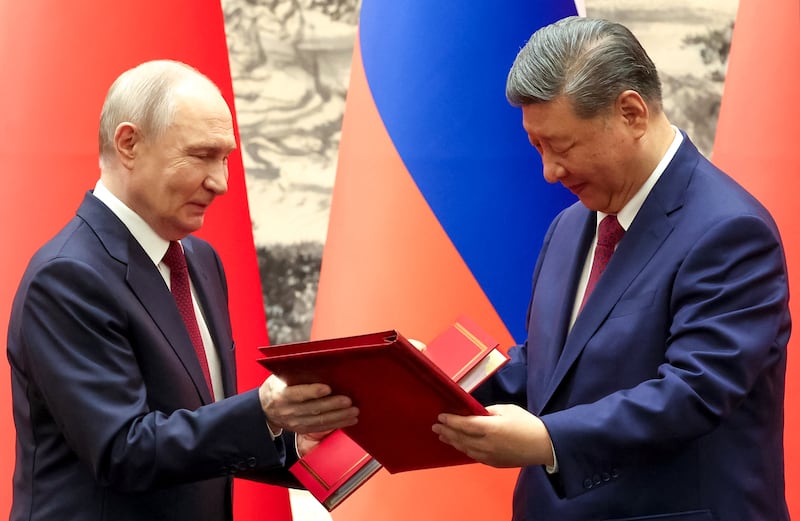
Xi called for an immediate ceasefire in the US war against Iran, telling Putin further conflict in the region was inadvisable.
“A comprehensive ceasefire is of utmost urgency, resuming hostilities is even more inadvisable and maintaining negotiations is particularly important,” he said.
Putin noted the increase in trade between China and Russia, pointing out much of the trade in energy is settled in Chinese yuan or Russian roubles rather than US dollars. He said Russia remained a reliable supplier of oil and gas to China, which was a responsible consumer.
He claimed Russia and China were united in their commitment to defending cultural and civilisational diversity while respecting the sovereignty of other states.
“We stand for respect for sovereign development of states and we aspire to build a more just democratic world order,” he said.
[ Trump accuses his opponents of treason. But it’s clear who the real traitor isOpens in new window ]